Monday, March 12, 2018

A Realization Of Progress

When I last wrote, I was thinking I would be back on task again, pumping out blog articles. But, my muse only really sails on calm waters. Try as I might, my life seems to be occasioned by squalls. But I am motivated and have things to say.  I will again try to rededicate myself and get back on my regular schedule.

A year ago today I was sitting in this exact same spot, the corner of my big cities’ bonsai garden.  I was here for the exact same reason. My employer had asked me to attend an IT conference that ran over a Friday-Saturday, leaving me unwilling to make the hundred and eight mile round trip home just for one very short day. I elected instead to just stay over. The visitor traffic is heavy this morning and it isn’t the tranquil spot of reflection it really could be. Still though, it is a nice place to be. Working at home for so many years I got fairly good at tuning out distractions. Children specifically.  Did you know “bonsai literally means tray planting or tree in a pot”? I do because I am sitting next a sign saying so and every parent walking through reads it to appear a genius to their kids.

Another thing I am reminded of by being here is just how far my van project has progressed. A couple of days ago Facebook was kind enough to remind me of my post the night I hooked up the house batteries. I also remember it was the night before this conference last year that I got the gas pipe and wires run to hook up the furnace. It was my original plan to spend my first overnight in the van on the Friday night. I was hoping to park within walking distance so I could have a very short commute Saturday morning.

In the end, this plan was foiled. When I left Friday evening, I could smell propane as I walked up to the van! When I opened the driver's door the smell was overpowering.   I had a gas leak in the pipe connections I had plumbed the night before. I had to turn off the gas and then very carefully go around and open all the doors to let it air out. I was just lucky I hadn't had to explain to police it wasn’t a car bomb that went off just a matter of stupidity. I spent the next several months with off and on gas leaks until I determined I had used the wrong connectors and replaced them all. But that night I had to seek other accommodations.

Back then, I had just the barest shell of what I have now. I had no mattress, I had no insulation.  It wasn’t going to be a comfortable night, it was going to be a milestone night. This year was a different story. The conference was about half an hour drive from my normal parking grounds and the check-in time was eight AM. I really shouldn’t be driving without coffee and though I am in much better shape van-wise than what I am now, I am having a few battery issues (which I will post about in the next few days). I don’t really have the spare power to run my coffee maker.

I discovered via google maps there was a metro train station with a park-and-ride lot which allowed overnight parking in a few designated spots. This lot was just four stations away from where I needed to be. I drove down there on Thursday evening and it was really great being able to wake up in the morning so close to my destination. I woke up, hopped the train and fifteen minutes later I had a cup of free conference coffee in my hand.  It was wonderful!

This isn’t a huge surprise but parking in a completely new spot doesn’t make for the best sleep the first night. There are all the new sounds and always the concern something unexpected could happen. A sign saying overnight parking allowed is one thing, quite another if some roll-through security suspects my living situation. Overnight lodging is not the same as parking and I could suffer the police pounding on the door at 3am. The second night is always much better for some reason.  Maybe someday I will be over this. I will realize the truth I have been preaching to you for over a year now. Cargo vans are invisible and that it is a much safer world out there than the network news would have me fear.

At the IT conference one of the sessions I attended was a grammar in technical writing. Put together for attendees to learn to write better documentation. I enjoyed it, a room of geeks debating the Oxford comma. But one of the points the instructor pushed was to not double space after a period. It will be a matter of the old dog new tricks dilemma to try to train myself out something I learned all those years ago from Mr. Richardson in twelfth grading typing class. I am going to try. I have been hearing this from other sources as well and finally need to make the jump.

Thursday, March 1, 2018

Snow Days and the Stealthy Couple


Good scheduling, the gods, and twelve inches of snow all conspired to allow The Wife and I to spend ten days straight together.   She joined me, the two of us living in the van for three nights while I spent my work days in the office. We had the van in a good spot, we didn’t move it all week. During that time however I didn’t write a single word for this blog.  I was in a way, quite proud of myself. —Because I have obsessive tendencies.  Instead I devoted myself strictly to quality time.  Even so I had a bit of a backlog.  I was able to publish three times despite my total inactivity.  After this time though I fell prey to Newtonian physics.  I was an object at rest that stayed at rest for the next month and a half.

It has been consistently cold here in the Northland.   What we locals call “a cold winter.”  Most nights have been below zero, sometimes the daily highs are as well.  Weather like this makes me not want to move the van much.  I have found a couple pretty good parking spots and content myself with revolving between them. I work.  I either hang out at work until eight or nine, or I find a pub to drop into until then.  I open up my blogging tool.  I read the couple of paragraphs of what has eventually become this post.  I diddle with grammar and tense.  I ponder the orphans, the stray sentences I have written.  Then I spend the next couple of hours Trolling for Trumpets on Facebook and reading news sites.  It hasn’t been an exciting existence.

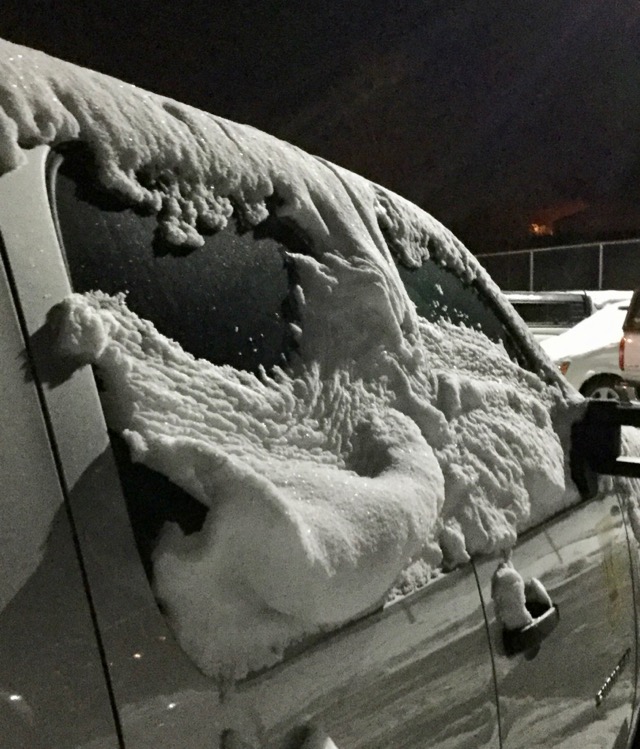
Snow buildup on the solar panels.
It was really fun having The Wife come and spend three nights in a row with me.  Lately we spend a lot of time talking about the future.  She and I are roughly five years out from empty-nestdom.  We love our children (no matter what they say about us) but seriously, this is a moment we have been anticipating for just over nineteen years.  As it inches closer we spend more and more time talking about what life will be like and what we plan to do with ourselves.  I have untested gypsy-like thoughts.  My bride is very much a homebody who has no idea where in the world she wants that home to sit.  Overlay that on an X-Y matrix of what we like -vs- what we can afford and you pretty much have our discussions in a nutshell.

What we are both pretty sure of is we have grown tired of six (or more) months of ice.  Last month when The Wife fell on our icy stairs was the turning point for her.  It has been a couple months and she still is moving gingerly.  She has to be careful sitting and one arm won’t reach the same as the other.  She went from cavalier-post-teen to "done with snow and cold" literally overnight.

The thing is neither of us have lived anywhere else and this is a very big country.  I dream about spending some time exploring it.  Likely we are always going to be urban dwellers and so a vehicle like the BV in some ways could be perfect for living on the road.  Rolling from city to city.  Seeing the sights.  Seeing where we like.  More important, seeing where we don’t.  A couple of years ago I did two interviews for a job down in Little Rock Arkansas.  It was winter here and those seventy degree forecasts were looking pretty appealing.  It ended up not working out (obviously) but in the meantime of the interviewing process I wrote a couple of friends of friends who live down there.  The realization my Bernie Sanders sign wouldn’t be welcome in most neighborhoods was a factor in our realization just how much we wouldn’t fit in.  …Almost more than the fact the position reported directly to the governor and paid $67,000.

So we know there are places we don’t want to live, how do we ferret them out? What I wax poetic about is living a life where we would travel around, finding towns where we would like to stay a while and landing in an AirBnB.  Live there a couple of weeks or even a month but in-between we would be living out of some sort of stealth camper.

The Wife seems to believe this would be entirely too much me in too confined of space.  As I look at it, the only way to dissuade her into any sort of nomadic lifestyle is to simulate it.

These are the types of things we need to figure out.  Five years from now I hope it will be van version 2.0.  Maybe by then I will have the money for a Sprinter van instead of the fifty inch ceiling I deal with now.  Being able to stand up isn’t critical for me, just needing four night a week cheap lodging.  Seven days a week for an indeterminate length of time is another story.

I just know my digital photo album is full of screen shots from Instagram.  Van dwellers who shoot pictures looking out the backs of their vans.  The view out that back window is limitless.

Monday, January 22, 2018

It is a Control Issue

I got together with a group of friends tonight who I hadn’t seen for a few years.  It was fun seeing these people who I used to connect with every week over softball.   …the couple years I was motivated enough to play softball, that is.  But now it had been a few years. The last time I saw them it was at the funeral of one of our players.  On the upside, at this happy hour none of us were dead.  But at one point we talked about our lives and our aches. The impact of aging.  No, we weren’t dead, but the yet was implied.

I have to confess part of the reason I have stretched out the installation of the solar panels over four blog posts is because it took forever for me too.  Everything about them went slower than expected.  The delivery, building the frame, rebuilding the frame.  It all took forever for me too.

In the meantime the solar charge controller has shown up.  It was larger than I expected it to be and on top of that, it requires six inches of headroom above what is truly an impressively large heat sink.  Where I had planned on installing this device won’t work at all so it was back to the drawing boards on that for a bit.  What I ended up coming up with, I have to confess I am really happy about.

Looking in from the back doors you can see my control
panel and how little space I have to go on the left.
My original plan was to have attached it to the back side of my bed, next to the back door, which has turned into my defacto van wiring control panel.  It has been sort of amusing/scary to me.  We have all had the experience where you start to hand write a sentence, maybe as you write and think you add another word.  Suddenly you start to look at the edge of the piece of paper looming closer.   You tighten up your words  and letters hoping to make it.   That’s called “kerning” btw for all you non-typography-geeks out there. It’s the same way with my control panel.  When I started out I had real estate between components.  The spacing has gotten tighter and tighter as I have moved across the board.

That’s why when the charge controller showed up I realized I had a problem.  The spot I was going to put it, because of it’s height, it would be hanging down interfering with propane tank swapping.  This stuff sure looks smaller on a five and a half inch screen!

All the wires going into the charge controller.
I had to find it a new spot but you know where I live.  I don’t have a lot of spots.  I thought about putting it up in the cab behind the passenger seat maybe. The advantage is I am closer to the solar panels and closer is better for voltage drop reasons.  But, looking at the thing, it has this huge heat sink on it.  Even a layman like me knows that means it must produce a lot of heat.   Do I really want to put it up in the cab where it is already going to be really hot?   All that extra heat could cause damage in the unit itself. 

For the same reason I ruled out putting in my living space.  I haven’t totally given up the thought of someday putting in a refrigerator.  Those put out a lot of heat themselves, I didn’t want to add even more heat to the living space.  Heck, I even thought about building a box for it under the van.  The perfect spot really except for all the road salt six (to seemingly eight) months a year.   Really when it came down to it though the only spot I had was back by my batteries and rear doors.  The area I call the garage.

The solar charge controller in its "swung out of the way"
postion.  When swung in, it is under the fuse.
I’m sittin’ in a bar right now so I can’t tell you for sure but I am thinking this unit is maybe ten by ten inches square and maybe fourteen high.  Then you have to figure the headspace of six inches it needs for cooling.  Some of the wires might have to enter the unit through the bottom, that adds even more apparent height.  I live in a world where a cubic foot is a really big deal.  There just wasn’t a whole lot of places I could even attach this thing.  The only place it could really fit was a place it was totally in the way.  It would be nice if I could install it there and then just swing it out of the way when I needed to.

In the end, that’s exactly what I did.  I used two pieces of 3/4” plywood and two large hinges.  I countersunk the hinges so the two pieces of plywood formed a book.  I attached the front cover to the charge controller and the back cover to the van.  Wha-Laa, I had the controller where it needed to be and would be able to swing it out of the way when I need access to the batteries or the inverter.  The multitude of wires I was able to run down the hinge line, then behind the “book” in the space with the weatherstripping so they stayed very much out of the way as well.

The patch I put in to cover the tear I made
in the insulation.  The patch doesn't need to be
water tight, it is to prevent oxidation.
The charge controller takes a lot of wires coming to it.  Number four gauge wires coming down from the solar panels, even thicker number two gauge wires going to the batteries.  Then all the other stuff.  There is a temperature probe that runs from the controller to the batteries.  There is a voltage sensor (thin) wire that has to go to your battery bank.  Two ethernet cables, one going to the van network and the other to the remote control panel.

The wires from the charge controller to the batteries is number two gauge jumper cables that I have cut the ends off.  Using the jumper cables had some advantages.  First off, it was cheaper to buy jumper cables than it was to buy raw wire from the welding shop.  The second, jumper cables are idiot proof!  I need that!   They are color coded red and black whereas the welding cable is any color you would like as long as it is black.  Henry Ford would be proud.  I did have one problem.  I needed to separate the two wires and did so by pulling them.  I wasn’t careful initially and caused some tearing of the insulation on the wire itself.  I caught myself doing it though and so was able to fix it right up with some heat shrink tubing.  I wanted a really good seal so I used three layers of tubing, one over the tear and two overlapping over that.  I feel confident it is air and moisture tight.

The faring coming up through the van roof.  Red for
positive, black for negative.
Up on the roof of the van I had two wires going to the solar panels.  So far they were just raw wires.  I bought some MC-4 connectors off Amazon.  They come in pairs, I really only needed one pair, wouldn’t hurt to have a backup.  Smallest quanitity you can buy?  Ten pair.   Ah well.  They were $20.  At the same time I bought a “Renogy MC4 Solar Panel Mc4 ASSEMBLY Tool”  because it was advertised on every Amazon page that other buyers had purchased one of these as well.  Total waste of money.  Only an extra seven dollars but they got me.   What you will need is something I already had, a crimp tool.  This tool locks the connector down onto the wire but doesn’t deform it so it still fits into the little plastic MC-4 bits.

The wire stripping guides to attaching these connectors are important.  This is something you have to follow the instructions and do it just right, otherwise you won’t get a water tight seal.  Once you get the ends crimped in place though it is slick, one solar panel connects to the other one (because my panels are in series) and then you just snap connect the two wires coming up from the van to the panels.

A nice sunny day in the early fall and
I am pulling in 337 watts at 25.3 amps.
It was a big job getting this all hooked up.  Really once this was done, dropping in the solar panels (once they fit) was totally anticlimactic.  After a test fit, I lifted the panels back out and drilled three holes per panel side through the side of the steel frame.   Then I dropped the panel back in and attached it with some stainless steel self tapping sheet metal screws into the aluminum frame of the panel.

I have been looking forward to this moment in the van project for a long time.  It is really an indescribably cool feeling to look at numbers the first time and realize you are generating electricity from sunshine.  Kind of like the first person who dug a hole deep enough in arid land and discovered water.  You realize that you have harnessed something willing to help you survive.

Friday, January 19, 2018

Swing and a miss...

It was nineteen below zero yesterday morning in the wasteland I call home.  This afternoon I filled out two job applications in a city that was sixty.  I don’t need eighty five and a beach but living someplace where the cha-ching of the gas meter turning doesn’t keep me awake at night seems kinda nice.

When we last talked I had just gotten the frame for my solar panels built and I had turned down Number One Son’s offer to have a friend powder coat it.  Yeah, I totally should have had this solar panel rack powder coated.  Instead I elected to spray paint it myself which turned out to be a pretty huge job really.  Getting good coverage in all the nooks and crannies with spray paint seemed to be impossible.  The expanded metal had all these inside edges which needed paint.  So painting the frame was a job that sucked but I didn’t know what was coming next.

Four holes drilled through the roof
of the van.
With delays and rain storms and running out of paint and even more trips to the hardware store, the process of painting the rack took about three weeks.  Finally though I had it ready enough.  Like I said before, I could have sprayed another dozen cans onto this frame.  The coat of paint on it is thin and seems to chip easy but I had enough.  I wanted to move on.

I had number one son stop over and between the two of us we lifted the painted frame up onto the van.    I made one last trip to the hardware store and picked up a whole bunch of U bolts, washers and nuts along with a few drill bits to fit.  Drilling steel it is much easier to have a nice sharp new bit.

Along with having the frame built I bought some 12ft long sticks of 1-1/4” square steel tubing.  This is the same material we built the pipe holder out of.  These sticks I drilled with holes just fore and aft of the cross braces of the roof rack.  Then I ran a U bolt through the holes and over the cross brace.  Flat washers and lock washers both for this application.  The idea here is to let these be the platform for the rack to set down on.  I spaced three of them somewhat equally across the space from the frame attachment ears over to the upright on the passenger side of the roof rack.

Cutting between the holes to make the hole
to attach the faring.
Once I got these in place I bungie corded the frame attachment ears in place, then I tipped the frame up and braced it up.   Then  went inside the van and made the final decisions on where I wanted the solar wires coming down into the van.  I measured and marked the four corners of a little faring I bought.  I drilled out the four corners with a bit large enough to allow my jig saw blade to pass through.

Back up on the roof I used my portable jigsaw to connect the dots and cut this square out.  I layered up a good double thickness ribbon of the butyl tape on the edge of the hole.  I drilled several holes around the edge of the faring then attached it with some half inch self taping sheet metal screws.  Drawing it down until the butyl tape was squeezing out from all the way around.

With this all done, I tipped the frame back down and undid the bungie cords.  Then attached more U bolts to attach the ears to the roof rack.  As a final step I used some strapping to attach my six inch PVC pipe.  My frame was all in place.

All set to drop my panels in and hook them up.  This is all really going great.  How often have you just finished saying that when everything goes to shit?

The U bolt I used to attach the frame.
Here is my best explanation for what went wrong.  The damn thing shrank.  No really.   Metal shrinks and expands with heat.  The expanded metal must have been hot from the grinder cutting it before it was welded in place.  Anyway the middle area of the frame where the expanded metal was attached was bowed in almost half an inch.  The Welder stopped by and with a grinding tool cut a slit in the expanded metal.  That helped a lot but not really quite enough.   It was a crazy deal.  We had those solar panels installed in place when he originally tack-welded the frame together.  Then we pulled them out so they wouldn’t get damaged by sparks and he finished welding it up.

With the cut expanded metal the panels almost fit in but I am a woodworker.  If something is a 16th off, you just run a belt sander across it a couple of times.  In metal it doesn’t work out that way.  Another couple of weeks had to go by for the stars to all align, then Number one son took the van out to the shop and they cut it apart and welded it back together.  I guess it took a couple of tries to get it right.  I was pretty happy The Welder considered this a warranty job.


Wednesday, January 17, 2018

Blending in With Solar

I grew up a farm kid.  People in that demographic tend to have a pretty wide skill set.  But for those of us who have moved off, it isn't a skill set we have maybe used in a while.  In theory anyway, one of those skills I have is welding.  But the last time I welded anything was 30 years ago.  Building a grid work of pipes so a movie production company could hang lights over a set.  It was up next to the ceiling on a hot summer day and after the first few welds I was totally overheating.  Taking full advantage of my maleness I whipped off my shirt and spent the next several hours finishing the job. …not to mention getting easily the worst sunburn of my life.  Ah but isn't all education expensive in some way?  Welding puts out a ton of ultra violet light.  Pipes never fell down.  That’s the important part.

I have my solar panels, I want to mount them to the roof of the van.  But I don’t really want them visible because that breaks stealth.  I have to have a couple of pretty good sized (Number 4 gauge) wires coming down from the panels and going into the van.   It would be very nice to disguise those wires in some way as well. 

Underside of a frame corner.
What I came up with as an idea was to build a steel frame.  I would paint it white so it would blend in and cover the black edges of the solar panels.  The frame would have some sort of textured metal that would cover part of the underside to provide some busyness the eye would tend to just flow over.  But most importantly it would hide the middle part of the backs of the solar panels where the wires attach.  The last design feature I wanted was to have the frame hinged in some way so if I was really desperate for electricity and didn’t need to be stealthy I could tip the panels up and increase my solar collection.

On the side of this frame I wanted a bracket that would hold a six inch PVC pipe.   If you start to watch cargo vans you will see them all the time.  I think carpenters use these long pipes on their roof racks to hold thin pieces of wood trim.  Well I wanted a pipe just like that.  Behind it, the wires could drop down from the solar panels and enter the van through two holes I will cut in the roof.  My PVC pipe will hold folding chairs and maybe a tent. :-)

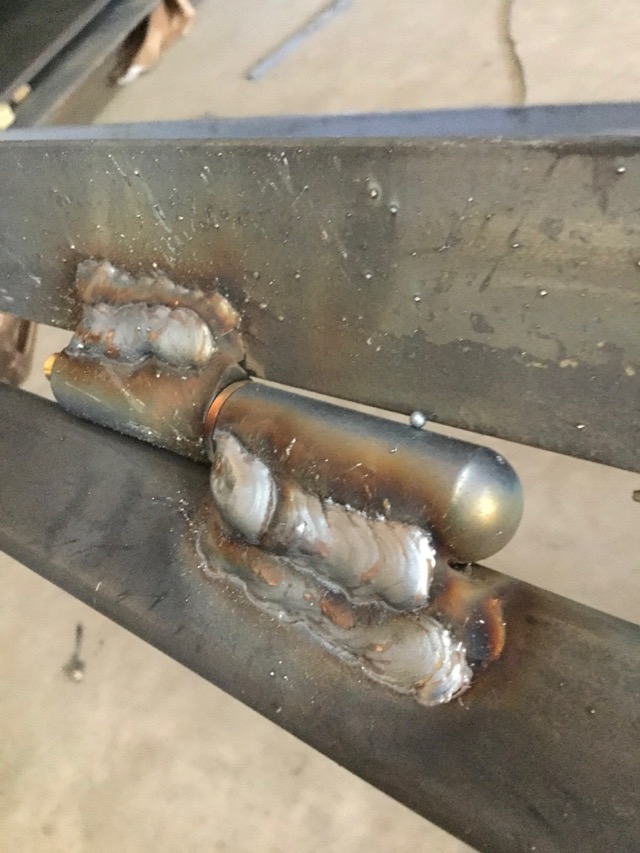
Tacking the weld on hinges.
During this van building work I gave really serious consideration to doing this job of building the solar frame myself.  The shop that I am working at has a full metal fabrication area with welders and the like.  But I don’t really like working with metal as much as wood.  I would have to do some cutting and I am not very familiar with metal cutting band saws.  The shop offers training on all this stuff once a month so I could have done it.  But, did I really want to?  This is to be a frame, holding something expensive, on the top of my van.  A weld breaking loose at speed could be way more excitement and cause way more damage than what I really need at this point in my life.  I decided against it.

I got in touch with number one son and he, in touch with his redneck network.  As it turns out I ended up going with the same guy I hired for cutting the hole in the floor of the van and building the basket for the propane tanks.  I got him a drawing of what I had planned and we setup a Saturday to do it.  The really great thing about working with one of these young, positive thinking kids is they are really open minded to building something non standard.  And, even more important, they have already built lots of custom stuff.  They have a lot of really great ideas on their own.

The first thing we looked at was the bracket to hold the pipe and the hinge.  My original idea was to use two pipes of the diameter they could nest together.  I would have the smaller diameter pipe attached somehow to the van at the edge of the roof rack. I would have the larger pipe attached to the solar frame.   The frame would extend out beyond the hinge point and to the under side of this extension would be this custom pipe holding bracket to be built.

My original design for the custom pipe
holder bracket and frame with pipe hinge.

But I had to concede two points.  First off this bracket was going to be a tremendous amount of effort to produce.  The only way I knew to cut a 6 inch radius in heavy steel was to cut it with a torch. Then grind it smooth, but that process could run an hour per bracket.  I felt like I needed three of them.  The second point against my design was with the hinge point back at the roof rack. Tipping the solar panels up would cause the pipe to strike against the side of the van if tipped more than about thirty degrees.  At my latitude I have to tip my panels up to about 66 degrees in the wintertime.   My design accounted for this by making the bracket swingable.  I would be able to unhook something or other and let the bracket swing down and not hit the side of the van.

In the summertime, sun bright in the sky, I am not going to have a shortage of solar problem.   The time I am going to need to resort to these extreme measures to gather electricity is in the dead of winter on one of those bright clear twenty one below zero Fahrenheit days.  Those days, am I really wanting to be diddling with some kind of (frozen) fastening system on my big white pipe?  Something I am going to only really be able to access from an icy stepladder?  No.  No, that is what you call a design weakness right there.

Cutting sheets of expanded metal.
The Welder took one look at this and made an immediate design change.  He had some weld in hinges.  What he suggested was to move the hinge point out to the outside edge, we would double up the frame and let attach back at the roof rack via some two foot long “ears” from the frame.  It solved the whole pipe hitting the van problem because the pipe would never move.  It would be below the hinged frame.   No fuss, no muss, I would just be able to tilt the panels up without having to touch anything about the pipe.  This was a fantastic idea.  Exactly why I like going to guys like this.

For the under part he had some “expanded metal”.  Imagine taking a sheet of steel and cutting a whole series of little slits in it.  Then, pull it from the end and the slits open up to form holes.  This is what expanded metal is.  I picked out some that had the added feature of being flattened.   They take the expanded metal that has sort of a twist to it that leaves lots of exposed sharp edges and run it through some sort of roller that flattens it all out.

The underside of the solar panel frame before the pipe
holder and attachment ears are welded on.
It was really interesting watching the whole fabrication process.  Number One son and The Wife were both there as well so it was a fun time.  The Wife is a townie and had never been in a metal shop before, let alone seen the entire process of building something.   Before the day was over she had a welding mask on and really seemed to have a good time.

The frame came together well and I think it took us maybe five hours all told.  But one thing to factor in, this was one guy working and three people asking him questions.

Here is where I made a little bit of a mistake.  Number One Son said, “I know a guy who can powder coat it.  You want me to run it over there?  Take a couple of weeks...”  Powder coating is when you take plastiscised paint particles (dust) that have a positive charge to them.  Then you take your object, in my case a solar panel frame, and you put a negative charge on it.  The dust sticks to the object due to static electricity and some long forgotten property described to me in a college physics.  Then you run the object into an oven and you bake that paint right on.   It makes a great finish.  Really hard and long lasting.

This is a weld on hinge at the edge of the
solar panel frame.
Two weeks?   Nahhh, I’m gonna paint this whole thing this afternoon!   I confess, this is the largest object I have ever spray painted.  I didn’t realize how little actual paint is in those little cans when it comes to covering something of this size.  I figured a couple of cans of primer.  It was more like five.  Must have taken six or seven cans of white and three weeks.  Really it could have used a couple more.  I totally should have had it powder coated.

The frame is all built, the next step is to mount it on the van.


Monday, January 15, 2018

By The Light Of Day

Solar stuff is confusing I will grant you that.  I spent about two months doing solar panel research and quite frankly, when I was all done, I felt like I knew less than when I started.  There is a ton of information out there but a huge selection of equipment on the market.  Having such a diverse selection, and rumors of incompatibilities, makes it difficult to find someone who is using the same configuration of equipment.

Before I get into all that though…  Something for you to check out, I have setup a Living on The Stealth Facebook page. Just click on this link https://www.facebook.com/livingonthestealth/  ‘Like’ and ‘Follow’ this new page you can get all the me with 100% less politics.  Or, you know, 99% less, anyway…

 The dealers won't actually give you much advice. They will only tell you to consult an electrician.  Or, they try to sell you a package with a bunch of stuff you don’t need.  What I needed was two solar panels and something to allow those panels to be hooked up to my batteries to charge them.  That was it.  I didn’t need a bunch of extra stuff, I didn’t need a bunch of mounting hardware.  I am going to tell you what I bought and discovered along the way.  I don't vouch for this information at all other than to say it seems to currently be working for me.

First off I checked with the solar guy I occasionally run into at the grocery store on weekends.  He and I have talked solar for years.  Even before solar we had talked about alternative home heating when I ran one of those blogs.  But, he has gotten to be kind of a solar big shot in the area now.  I sent him what I was looking for and some questions on what I was confused on.  He sent me a picture of the job he just finished, which was like sixty panels on a stock building, and a promise he would get back to me in a couple of days.  That was the last I have heard from him.

Starting out I contacted a company called Wholesale Solar. They advertised their low prices and helpfulness so I was hopeful.  A disadvantage might be I don't like to call anyone.  I always just figure email I can re-read, I can formulate questions. I can be effer-goddamn-vessent.  On the phone, not so much.

But emailing Wholesale Solar was about a week turn-around per mail.  The replies I got seemed to be cut and paste jobs. I realize I don't have a standard situation here with panels on the top of a cargo van. So I was making some allowances for a bit of confusion.  The other thing, I was asking for a bunch of information on a two panel order.  I am guessing if I was talking about two hundred panels I could have gotten a little better service.  The replies from Wholesale Solar seemed like the person hadn't read the exchange at all and finally I gave up.

Id like to send some information about the panels we offer. It sounds like you have a really cool project, but Im not sure the 260w or 295w panels will work for your project. How much space do you have? These panels are about 6’ x 3’. When we size panels for RVs or vans, we typically use the smaller 100w panels which are much smaller. Here is a link to an rv system on our website. Ig this is something you would like to pursue, let me know!
This is a two panel rv kit-
https://www.wholesalesolar.com/1890250/wholesale-solar/complete-systems/sundancer-rv-kit
And this is a four panel rv kit-
https://www.wholesalesolar.com/1890260/wholesale-solar/complete-systems/king-of-the-road-rv-kit
Thanks for reaching out.
Ricky Raffaini
412 N. Mt. Shasta Blvd.
Mt. Shasta, CA 96067
Toll Free: 800-472-1142
Local: 530-926-2900
Fax: 530-926-1162
http://www.wholesalesolar.com

I emailed back to them some additional information about the project and then the second reply referred me to a $7000 package with four panels for a house rooftop install.

Solar panels have special DC connectors.
Next was Renogy Solar.  This place was actually worse than Wholesale Solar.  I wrote to them, they answered nothing in their email, it was total marketing BS including a link to a package that cost almost $6000.  When I replied, again describing my project, I got the same exact email reply from them.

In the end I just took a shot in the dark.  I ordered both the panels and the charge controller from Amazon.  Which when I was doing it, seemed insane.  But I had no real sources for other information. I had no idea if what I had bought would all work together.

I picked out two Hyundai Solar - Hyundai 250 Monocrystalline solar panels.   They were supposed to be delivered on a Wednesday.  I had my welder guy lined up to build a steel frame for me over the weekend.  Paint it, and mount in on the van.  Wire’em up in a couple days and leave with The Wife for a week camping the following Tuesday.  Yeah, that was the plan.  It didn’t even seem ridiculous at the time.

It was though.  It didn’t work out that way at all.  Solar panels are too big to come by UPS or Fed-Ex, they have to come by truck.  The order to the trucking companies is supposed to have the phone numbers contained in your amazon account.   I didn’t even know Amazon had my phone number.  In fact they didn’t.  One was to the landline phone in our current house, the other a state and a house ago and the third number I didn’t recognize at all.  The trucking company will only deliver to a residential address if they can call someone on the phone first.  Failing that, they drop a postcard in the mail.  I assumed since I had been tracking these things across the country four days, if someone was at the residence on the day the web site said out for delivery, it would in fact be delivered.  No, that is not the case.

I ordered 250w panels, I got 270w.  Every
watt helps, I guess but there are so many
panels with so many different features.
I gave them an extra day, past the Wednesday deadline but on Friday morning I started trying to track them down.  I started with the Amazon seller, but he was out on vacation until the following Friday.  No, there wasn’t anyone else I could talk to.  I tried the trucking company, but trucking companies don’t seem to offer much customer service to residential customers.  In the end it was about three weeks later before I actually got the panels delivered!

When they did finally show up they were not the panels I ordered.  Very disconcerting since now more than a month had passed since I had ordered them.  I knew my Amazon return options would now be further limited.   Doing a little research on the panels it seemed like the ones I got were at least equivalent if not a little better.  Whew.

Solar is more than just some panels though.  You also need what is called a charge controller.  This unit will actually end up costing you as much or more than the panels if you want maximum efficiency.  There are really two paths to head down with charge controllers.   PWM or MPPT.  The better of the two, MPPT, of course costs quite a bit more, but there are good reasons why they are worth the money.

PWM, or Pulse Width Modulation works with 12 volt batteries and really can only work with 18 volt maximum solar panels any more than 18 volts gets discarded.  For solar panels, this is low voltage.  A basic fact of electricity is the lower the voltage the more of it you will lose going through wire.   You can combat this by using really thick wire, but that is cumbersome.  Also a problem with low voltage panels is, sure they are rated for 18 volts but that is (I think) at 43 degrees F.  If the temperature goes up, the voltage goes down.  Who would think a big black panel sitting in the sun would get warmer than 43?   This drops enough on a really hot day and you won’t have sufficient voltage to charge your batteries.

The solar charge controller with its cover off.
MPPT or Maximum Power Point Tracking on the other hand can accept much higher voltage coming in.  My panels are 39 volts but I have them wired in series so coming into the charge controller I actually have 78 volts total.  With that much higher voltage I am able to get by just fine on #4 gauge wire from the panels to the controller.  My battery system is twelve volts so the MPPT controller can convert the excess voltage into additional amperage to let the batteries charge faster.

PWM systems tend to not be as technically advanced either.  For instance I bumped up to a larger charge controller not because I needed the solar capacity but the one I got has a built in ethernet port.  I will be able to tie it into my network in the van and log how much solar I am receiving.  I have a small computer that has an adapter card in it with a compass, GPS as well as pitch and yaw.  With that information tied to the solar panel charge data I will know what direction to best face the van, where to park it and how much tilt I have.  I will know the best places to park.  But if I didn’t have the full log data from the charge controller I wouldn’t be able to do this.

I bought one other accessory to make this all handier.  A remote control panel for the charge controller so I can see the status of the panels just by pushing a button.  It is really just a subset of the data coming out of the ethernet port but much easier to get the answer to the “How much solar am I getting right now?” question.


Friday, January 12, 2018

Heating it up!


I got back to the van tonight after a technical user group meeting.  It is for a computer language I am trying to learn well enough to get by in my current gig.  An ice storm is just beginning.  Ah the joy of the frozen north.  Snow is predicted for later tonight and into tomorrow.  Just walking across the parking lot was a slippery adventure tonight.  It was not lost on me The Wife is still recovering from a fall.  By tomorrow sometime we are supposed to have five fresh inches on the ground.  Everyone’s morning commute is going to be a drag.  Even mine.

Sitting around inside I turned the furnace up.  It has been warm this week so I figure I have the propane to spare.  I hefted the tank on Monday night and determined switch-over must have taken place that day.  I think I had been running on the prior tank since Thursday but there were two very cold days in there followed by some not bad.

Sitting here tonight it occurred to me I should test my CO2 detector just to make sure the freezing temperatures in here hadn’t killed its battery.  I couldn’t find it anywhere.  I have done some level one digging around so far tonight.   I will think about it tomorrow and check in my cubical.  I know I have a couple of boxes of van parts in there.  There might be a couple more unlikely spots I can check in the van, but if that doesn’t turn it up I am going to have to buy a new one.   Just because I don’t see it anywhere doesn’t mean it wouldn’t turn up first thing in a forensics investigation.  I could just read the headlines, “Man found dead of carbon monoxide poisoning in van, CO2 detector found in cardboard box under the front seat.  Always thought to be a slow learner.”

The topic for the week seems to have been related to keeping warm.  I realized in that I haven’t mentioned the heat source much.  I have a Suburban RV furnace installed.  It is a 16,000 BTU unit hooked up to a wall mount thermostat.   The furnace runs on propane.  My fuel source is exchangeable twenty pound propane cylinders just like you use in your gas grill.  I can exchange them at most every gas station and many big box stores.

On the outside these propane tanks are all created equal.  But, what’s inside or I should say specifically how much propane is inside is another story.  You see all propane cylinders are not filled with the same amount of gas.  They are a twenty pound cylinder, meaning they *can be* filled with twenty pounds or about 4.7 gallons of LP gas.

I am a data collecting geek though.  What that means is after a few tanks I started questioning them weighing differently.  I bought a digital bathroom scale.  Nice one.  Cost me less than ten bucks at Target.  I weigh the tank when I buy it and record it’s weight in a spreadsheet.  Before I exchange it I weight it again.  The most gas I have ever gotten was eighteen pounds.  Typically it is more like mid-fifteens, one time only 14.4.  The lightest ones are not surprisingly from the gas stations.  Usually the brand on them for this area is Blue Rhino.

An empty tank runs about seventeen pounds so this one
is pretty good.  Almost nineteen pounds of propane in there.
Where the math starts to get interesting is when you start looking at the price per pound.   I park close by to a couple of Holiday stations where I can do propane exchanges.  But those tanks will be lite so I go through them quicker, and more expensive per pound as well.  At those places I am paying $1.20 to $1.54 per pound.  But, if I drive a few miles to a southern suburb I can get the eighteen pound fills for $ .96.  Quite a price difference.  But, is it worth the drive?

I am going to need another month's worth of data to really give you a good report on propane usage.  I feel like I am buying a propane tank typically every six or seven days.  Those really cold days it is more like four.  I hope to make a few changes in the next two weeks to improve that.  The complication is it will be tough to directly tie my usage to my purchases.  You see I have two tanks with a switchover valve between them.  When I finish one tank, it switches over to the other one.  But me, I am a procrastinator.  I only have to buy propane before the other tank runs out.  Just like I said earlier, I think one of my tanks went dry on Monday, here it is Wednesday.  I might not exchange it until Friday before I head home, but I can’t say that tank lasted me eight days.  It didn’t.  With enough data, I can level that all out with some averages.

This one, not so good.  Just over fifteen pounds.
The furnace also needs electricity from my batteries to run the blower fan.  I have been a little surprised how much the furnace draws.  It is enough I have been minimizing my other electrical usage, particularly during long multi-day grey spells where I am picking up very little solar.  Those days I watch my battery level indicator pretty close.   Now one thing that is on the upside.  Those really bitter cold days, where the furnace is running a ton, tend to be clear sky days.  Pretty good solar.

4.23 lbs per gallon a full tank should have 4.7 gallons in it.  So a full tank of propane should contain 420,000 btus in it.  My furnace being a 16,000 BTU unit should run 5.7 hours on one gallon of propane if it runs 100% of the time.  I have the capability, just not sufficient electricity to monitor and log my furnace run time.  Some day it will be interesting to correlate all this data.